Client Environment: NEPEAN Conveyors
Sector: Mining / Bulk Materials Handling
Project Type: Conveyor, transfer chute and crushing-plant engineering documentation
This project involved supporting the engineering development of bulk-material handling systems incorporating conveyors, transfer chutes and crushing-related plant layouts.
The work required multiple equipment and structural systems to be coordinated within a common industrial environment while maintaining practical material flow, equipment access and constructability.
My contribution focused on engineering design and technical drafting, layout development and coordination of equipment and structural interfaces.
The project strengthened my experience in heavy-industrial plant engineering and helped develop a broader understanding of how individual machines form part of an integrated material-handling system.
Project Context
Bulk-material handling systems are fundamentally about moving material reliably from one process stage to another.
A typical system may include:
- Feed equipment
- Conveyors
- Transfer points
- Chutes
- Crushers
- Supporting structures
- Platforms
- Access systems
- Drives and mechanical equipment
- Discharge arrangements
Each item may perform a different function, but the complete system only works when the interfaces between them are properly coordinated.
The engineering challenge therefore extends beyond designing an individual conveyor.
The wider question is:
How does material move through the complete plant safely, reliably and efficiently?
Systems-Level Engineering
One of the most important lessons from this project was understanding bulk-material handling as an integrated system.
The operating sequence can be simplified as:
Material Source → Feed → Conveyor → Transfer → Crushing / Processing → Transfer → Next Process
A problem at any interface can affect the entire downstream system.
For example:
- Poor transfer geometry can create spillage.
- Incorrect equipment positioning can affect belt alignment.
- Structural constraints can limit maintenance access.
- Chute arrangements can interfere with surrounding equipment.
- Poor layout decisions can increase future maintenance difficulty.
The project therefore required systems-level thinking rather than isolated component design.
Conveyor Layout Development
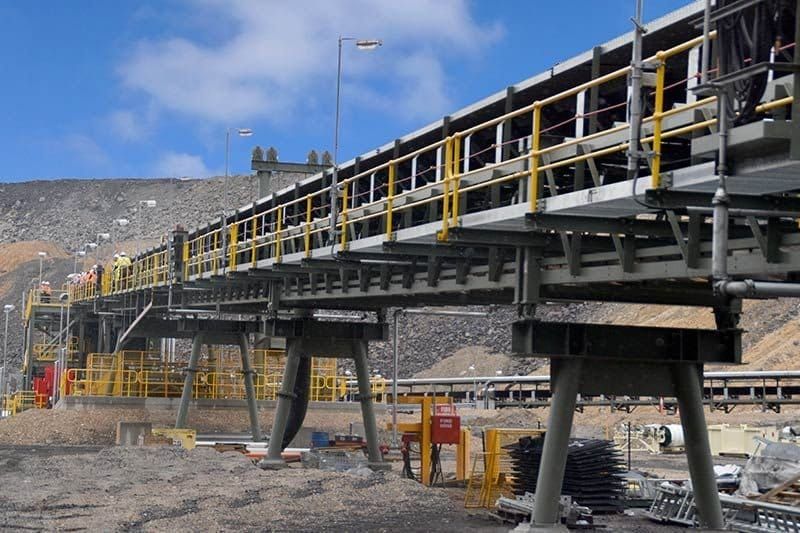
Conveyor arrangements needed to connect different parts of the plant while working within available site and structural constraints.
Layout development involved consideration of:
- Conveyor routing
- Elevations
- Transfer locations
- Supporting structures
- Equipment clearances
- Drive locations
- Access
- Maintenance zones
- Adjacent plant
A conveyor is physically long and interacts with many areas of a facility.
Its position therefore influences more than material movement.
It can affect:
- Structures
- Roads
- Walkways
- Equipment
- Services
- Maintenance access
- Future expansion
This strengthened my understanding of plant-layout engineering and multidisciplinary coordination.
Transfer Chute Engineering
Transfer chutes form the connection between conveyor or processing systems.
Although they may appear relatively simple, they can strongly influence material-handling performance.
The engineering documentation needed to consider how material moved from one piece of equipment to another.
Relevant considerations included:
- Material-entry point
- Discharge direction
- Chute geometry
- Equipment interfaces
- Clearance
- Support requirements
- Maintenance access
- Wear areas
- Dust and spillage considerations
The objective was to represent an arrangement that could integrate practically with the surrounding material-handling system.
Specialist flow modelling or detailed performance validation remained the responsibility of the relevant engineering disciplines where required.
Crushing Plant Layout
The project also involved layouts associated with crushing equipment.
Crushing systems introduce additional interface requirements because material needs to be delivered to the crusher and then removed efficiently after processing.
The surrounding arrangement may include:
- Feed conveyors
- Discharge conveyors
- Chutes
- Structural platforms
- Equipment supports
- Access areas
- Maintenance zones
The design therefore required consideration of both the crusher itself and the equipment surrounding it.
This reinforced the principle that industrial equipment is rarely truly standalone.
Structural Interfaces
Conveyors and processing equipment rely heavily on supporting structures.
Structural systems may include:
- Conveyor supports
- Platforms
- Towers
- Frames
- Equipment supports
- Walkways
- Brackets
My work involved coordinating the equipment layout with the corresponding structural environment.
This required understanding the relationships between:
Mechanical Equipment ↔ Supporting Structure ↔ Access ↔ Existing Plant
A technically correct mechanical arrangement can still become impractical if supporting structures or access requirements are not considered early.
Transfer Tower Coordination
Where conveyors change elevation or direction, transfer structures can become complex coordination areas.
Multiple systems can converge within a relatively small space.
These areas may include:
- Incoming conveyor
- Outgoing conveyor
- Transfer chute
- Supporting steelwork
- Drive components
- Walkways
- Platforms
- Maintenance access
This creates significant interface-management requirements.
The design environment therefore needed to identify spatial conflicts before fabrication or construction.
This was another useful step in developing my ability to think beyond individual drawings and understand the complete equipment environment.
Spatial and Clash Coordination
Heavy-industrial plant design contains many opportunities for physical clashes.
Possible conflicts can occur between:
- Conveyors and structures
- Chutes and structural members
- Platforms and equipment
- Walkways and mechanical systems
- Drives and surrounding infrastructure
Identifying these issues during design is far more efficient than discovering them during installation.
The coordination process therefore supported one of the most important principles of project delivery:
Solve foreseeable interface problems before they reach the site.
This thinking became increasingly important in my later manufacturing and project work.
Material Flow Thinking
The material itself is an important part of the engineering system.
Bulk materials can behave differently depending on:
- Particle size
- Moisture
- Density
- Flow characteristics
- Impact
- Abrasion
The equipment arrangement therefore needs to consider how the material is expected to move through the system.
My role was not specialist bulk-flow analysis.
However, working on conveyor and chute layouts strengthened my understanding that plant design needs to consider the physical behaviour of the product being handled.
The machine and the process cannot be separated.
Environmental Considerations
The current KEVOS case-study register references environmental-impact considerations as part of the project.
For the portfolio, I would describe this conservatively.
Bulk-material handling systems can create operational environmental issues including:
- Dust
- Spillage
- Material loss
- Noise
- Contamination of surrounding areas
Equipment layout and enclosure concepts can influence these issues.
Any specific environmental-performance claims should only be included where supported by actual project records or engineering calculations.
The safer professional position is that environmental and containment requirements were considered as part of plant-layout and equipment-integration work.
Maintenance Access
Conveyor systems require regular maintenance.
Common maintenance activities can involve:
- Belt inspection
- Roller replacement
- Drive maintenance
- Chute inspection
- Cleaning
- Wear-liner replacement
- Alignment work
Plant layouts therefore need to provide sufficient access around equipment.
This project reinforced an engineering principle that has remained important throughout my career:
Design equipment around its operating and maintenance lifecycle, not only around initial installation.
A compact plant layout has little value if essential equipment later becomes difficult to maintain.
Walkways and Operator Access
Bulk-material handling facilities also require safe access for inspection and maintenance personnel.
Equipment positioning therefore needed to consider the relationship between:
- Conveyor structure
- Walkways
- Platforms
- Access stairs
- Equipment
- Maintenance areas
The exact access and safety requirements were governed by the relevant project standards and engineering specifications.
My contribution was to coordinate these requirements within the technical layout and documentation.
Brownfield and Plant Constraints
Where material-handling equipment integrates into an existing facility, available space and infrastructure create additional constraints.
The engineering process then becomes:
Existing Plant + New Equipment + Required Material Flow + Access + Structure
rather than simply designing the ideal system on an unrestricted site.
This type of plant coordination helped strengthen the same brownfield-engineering mindset I developed through other heavy-industrial projects.
Design for Fabrication and Installation
Conveyors, chutes and structural systems eventually need to be fabricated, transported and installed.
Technical documentation therefore needed to support practical execution.
Considerations included:
- Component size
- Fabrication
- Structural interfaces
- Assembly
- Equipment access
- Installation sequence
- Site constraints
The project further developed my understanding that engineering design and construction practicality need to be considered together.
Technical Drafting and Documentation
CAD and technical drawings formed an important part of my contribution.
Documentation needed to communicate:
- Equipment position
- Conveyor geometry
- Chute interfaces
- Crushing-system layout
- Structural relationships
- Dimensions
- Access requirements
- Relevant engineering notes
These drawings provided a common technical reference for engineering, fabrication and project stakeholders.
The value of the documentation therefore went beyond drawing production.
It supported multidisciplinary coordination.
Design Change Management
Material-handling layouts can evolve as equipment selections or project requirements change.
A conveyor adjustment can affect:
- Transfer locations
- Chute geometry
- Structures
- Platforms
- Equipment interfaces
- Overall plant layout
This makes engineering change a coordinated activity.
The project strengthened my understanding that a change should be assessed for its wider consequences rather than treated as a local drawing update.
That thinking later became directly relevant to my product-development and operations projects.
Engineering and Construction Interface
The project further developed my understanding of the connection between engineering decisions and physical site execution.
The delivery chain can be viewed as:
Process Requirement → Plant Layout → Equipment Design → Coordination → Documentation → Fabrication → Installation
My contribution was focused mainly within the design, coordination and documentation stages.
However, understanding the later fabrication and construction implications helped broaden my perspective toward project delivery.
Project Deliverables
My contribution included work associated with:
- Conveyor-system layouts
- Bulk-material handling plant arrangements
- Transfer chute documentation
- Crushing-equipment layouts
- Structural interface coordination
- Equipment-support coordination
- Transfer-point development
- Plant-layout CAD
- Maintenance-access considerations
- Technical drafting
- Design revisions
- Engineering documentation supporting fabrication and installation
Detailed conveyor calculations, specialist bulk-flow analysis, structural certification and final engineering approval remained with the appropriately responsible engineers.
Project Outcome
The work produced coordinated engineering documentation supporting bulk-material handling systems within the NEPEAN Conveyors project environment.
From a career-development perspective, the project was important because it strengthened my understanding of flow-based industrial systems.
The engineering challenge was not simply:
Design a conveyor.
It was:
How does the material enter the system?
Where does it transfer?
What happens at each interface?
How is the equipment supported?
How will it be accessed and maintained?
How does it interact with the surrounding plant?
How will the design be fabricated and installed?
These questions are fundamentally systems and project questions.
Capabilities Demonstrated
Bulk Material Handling
Working with conveyor, chute and crushing-system layouts in a heavy-industrial environment.
Conveyor Systems
Developing and coordinating conveyor arrangements within a wider plant layout.
Transfer Chute Coordination
Understanding and documenting interfaces between material-handling equipment.
Crushing Plant Layout
Supporting the integration of crushing equipment with surrounding conveyors and structures.
Plant Layout Engineering
Considering equipment, structures, access and surrounding infrastructure as one system.
Structural Coordination
Coordinating mechanical equipment with its supporting structural environment.
Spatial Coordination
Identifying and reducing physical conflicts before fabrication or installation.
Maintenance Engineering Awareness
Considering equipment inspection and servicing requirements during layout development.
Design for Fabrication and Installation
Recognising how engineering decisions influence downstream construction activities.
Technical Documentation
Producing controlled CAD information supporting engineering, fabrication and project stakeholders.
Engineering Change Management
Understanding how layout changes influence several interconnected systems.
Systems Thinking
Viewing material flow, equipment, structures, access and maintenance as parts of one operating system.
Career Development
The NEPEAN Conveyors project represents another important expansion of my engineering perspective.
My earlier experience had developed across:
Tooling → Components → Structures → Machines → Mobile Equipment
Bulk-material handling introduced another level:
Continuous Industrial Systems.
A conveyor plant is not simply a collection of individual machines.
It is a connected process where the output of one stage becomes the input to another.
That required me to think in terms of:
Flow + Interfaces + Equipment + Structure + Access + Operation
This systems-oriented approach became increasingly relevant throughout my later career.
In manufacturing, I applied similar thinking to:
Material Flow + Production Equipment + Operators + Quality + Maintenance
and in operations excellence:
Process + People + Systems + Cost + Risk + Implementation
The technical discipline changed, but the fundamental thinking remained the same.
That progression from detailed technical design toward understanding complete operating systems has been one of the foundations of my move into engineering project delivery and operations excellence.