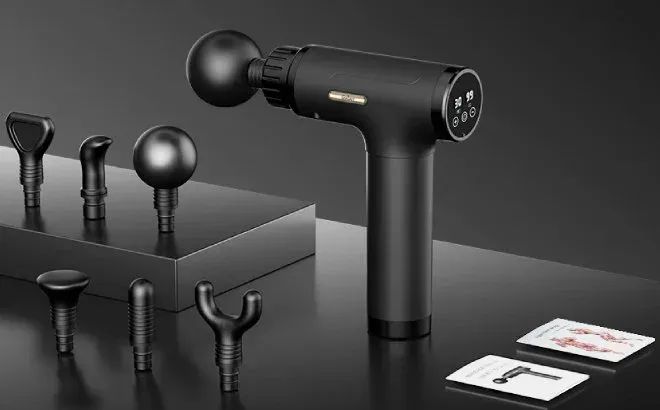
Project Status: Product concept and engineering design developed. Product was not progressed to commercial production.
This project involved developing a concept for a percussive therapy device for a Sydney-based physiotherapist seeking to explore an alternative to higher-cost products already available in the wellness and physiotherapy market.
The project required translating an initial product idea into a structured mechanical design while considering functionality, component count, manufacturability, assembly, appearance and potential production cost.
My contribution focused on taking the product from an early concept through design development and 3D visualisation, while applying design-for-manufacture principles to create a practical foundation for further prototyping and product development.
Project Context
The client had identified an opportunity for a percussive therapy product that could potentially provide the required functionality while being simpler and more economical to manufacture.
The engineering challenge was therefore broader than creating an attractive enclosure.
The product needed to balance:
- Functional requirements
- Mechanical simplicity
- User interaction
- Component integration
- Manufacturing feasibility
- Assembly complexity
- Material selection
- Product appearance
- Potential production cost
- Future scalability
These requirements needed to be considered together from the early stages of development.
Translating an Idea into Engineering Requirements
The project began with discussions around the intended product, target user and desired operating concept.
Early product ideas were translated into more structured engineering requirements.
Rather than immediately beginning detailed CAD development, the design process considered what the product actually needed to achieve and which features were essential.
This helped establish a foundation for subsequent design decisions.
It also reinforced an important principle of product development:
A successful product begins with understanding the requirement, not with creating geometry.
Concept Development
Multiple ideas were explored during the early design stage.
Sketching and preliminary layouts were used to examine possible product configurations before committing to detailed geometry.
This allowed alternative arrangements to be assessed relatively quickly.
The concept-development process considered the relationship between the external form and the internal mechanical architecture.
The intention was to create a product that could provide the required functionality without introducing unnecessary parts or manufacturing complexity.
Design Simplification
A major focus of the project was simplification.
Every additional component introduces potential impacts on:
- Manufacturing cost
- Assembly time
- Procurement
- Inventory
- Quality control
- Reliability
- Maintenance
- Production scalability
The product architecture was therefore reviewed with the objective of reducing unnecessary complexity.
Where possible, functions were consolidated and the number of individual components was minimised.
This is a principle that has remained important throughout my later manufacturing and operations work:
Good engineering is not necessarily about adding more. Often it is about achieving the required result with less complexity.
3D CAD Development
Once the general concept was established, the product was developed further using 3D CAD modelling.
The digital model provided a structured environment for evaluating:
- Component arrangement
- Packaging
- External geometry
- Assembly relationships
- Clearances
- Ergonomics
- Manufacturing considerations
- Overall product proportions
Developing the product digitally also allowed design changes to be incorporated progressively as the concept matured.
This iterative approach helped move the product from an abstract idea toward an engineering-defined concept.
Design for Manufacture
Manufacturing requirements were considered throughout the development process rather than after the product geometry had been completed.
Component complexity, assembly requirements and potential production methods influenced design decisions.
The objective was to create a concept that could potentially transition into prototyping and subsequent manufacturing without requiring fundamental redesign.
This required consideration of questions such as:
- Can the component be manufactured practically?
- Can the number of parts be reduced?
- How will the product be assembled?
- Are unnecessary tolerances being introduced?
- Can standard components be used?
- Will the design remain practical if production volume increases?
- How will design decisions influence unit cost?
These considerations helped connect mechanical design with the realities of manufacturing.
Cost-Conscious Engineering
Cost was an important requirement because the original product objective involved developing a more economically manufacturable alternative within an established market.
Rather than treating cost reduction as something to be addressed after design completion, manufacturing efficiency was considered during concept development.
Part count, component complexity and assembly requirements were reviewed as potential cost drivers.
This demonstrated the relationship between engineering decisions and commercial outcomes.
A seemingly small design decision can influence tooling, manufacturing time, assembly labour, inventory and ultimately the commercial viability of a product.
User and Product Experience
The design also considered how the device would be held, operated and perceived by the user.
Mechanical products need to perform technically, but consumer-facing equipment also needs to communicate its purpose through its form.
The concept therefore included consideration of ergonomics and visual identity alongside the engineering requirements.
The client also wanted the product to have a wellness-oriented identity rather than simply reproducing the clinical appearance of existing devices.
Design iterations explored how these characteristics could be incorporated without compromising the underlying mechanical concept.
Client Collaboration and Design Iteration
Product development is rarely a linear process.
Ideas evolve as the client sees the product taking shape and as technical constraints become better understood.
The project therefore involved iterative discussions with the client.
Concepts were developed, reviewed and refined as requirements became clearer.
Three-dimensional visualisation was particularly useful during this process because it allowed design ideas to be communicated without requiring the client to interpret complex engineering drawings.
This helped connect client expectations with engineering feasibility.
Product Development Thinking
This project gave me experience across several stages of the product-development process:
Idea → Requirements → Concept → Design → Review → Refinement → Manufacturing Consideration
The work was not simply about creating a CAD model.
Each design decision needed to be considered in relation to the product as a complete system.
Functionality, user requirements, manufacturing, cost and appearance all influenced the final concept.
Project Deliverables
The project development included:
- Client requirement discussions
- Initial product concepts
- Design sketches
- Mechanical concept development
- Product architecture development
- Component simplification
- 3D CAD modelling
- Product visualisation
- Design iteration
- Design-for-manufacture considerations
- Assembly considerations
- Cost-conscious design development
- Manufacturing information supporting potential further development
Project Outcome
A developed product concept and associated engineering design information were produced for the proposed percussive therapy device.
The project demonstrated a potential pathway from an initial client idea toward a product capable of progressing into further prototyping and manufacturing development.
The client ultimately decided not to progress the product into commercial production.
The project should therefore be viewed as a product-development and engineering-design project, rather than as a commercially launched or production-validated medical device.
Capabilities Demonstrated
New Product Development
Translating an initial product idea into a structured engineering concept.
Requirements Definition
Converting client objectives into practical technical and product requirements.
Mechanical Design
Developing mechanical architecture and component arrangements using engineering design principles.
3D CAD Development
Building and refining product geometry within a three-dimensional design environment.
Design for Manufacture
Considering production methods, component complexity and assembly requirements during product development.
Design Simplification
Reducing unnecessary components and complexity to improve manufacturability.
Cost Engineering
Understanding how engineering decisions influence manufacturing and potential product cost.
Design Iteration
Progressively refining the design through technical assessment and client feedback.
Client and Stakeholder Communication
Translating technical concepts into visual information that could be discussed and reviewed collaboratively.
Commercial Awareness
Considering the relationship between design, manufacturing cost, product positioning and potential scalability.
Career Development
This project represents an important part of my development because it required me to think beyond technical drafting and consider the complete path from an initial idea toward a manufacturable product.
It strengthened my understanding of the relationship between:
Customer Need → Engineering Requirements → Product Design → Manufacturing → Cost → Commercial Outcome
That thinking later became highly relevant to my manufacturing and operations work.
Whether developing a consumer product or improving an industrial production line, many of the same questions apply:
What problem are we actually solving?
What does the customer or stakeholder require?
Can the solution be simplified?
Can it be manufactured reliably?
What will it cost?
How will it be assembled?
How will changes affect downstream operations?
What needs to happen to move the concept into implementation?
This ability to connect technical design decisions with manufacturing and commercial considerations has contributed to my progression from detailed product design toward broader engineering, operational improvement and project-delivery responsibilities.