Engineering Partner: NID Pty Ltd
Industries: Food | Pharmaceutical | Cosmetics
Project Period: 2013
Project Type: Special-purpose machine development and manufacturing
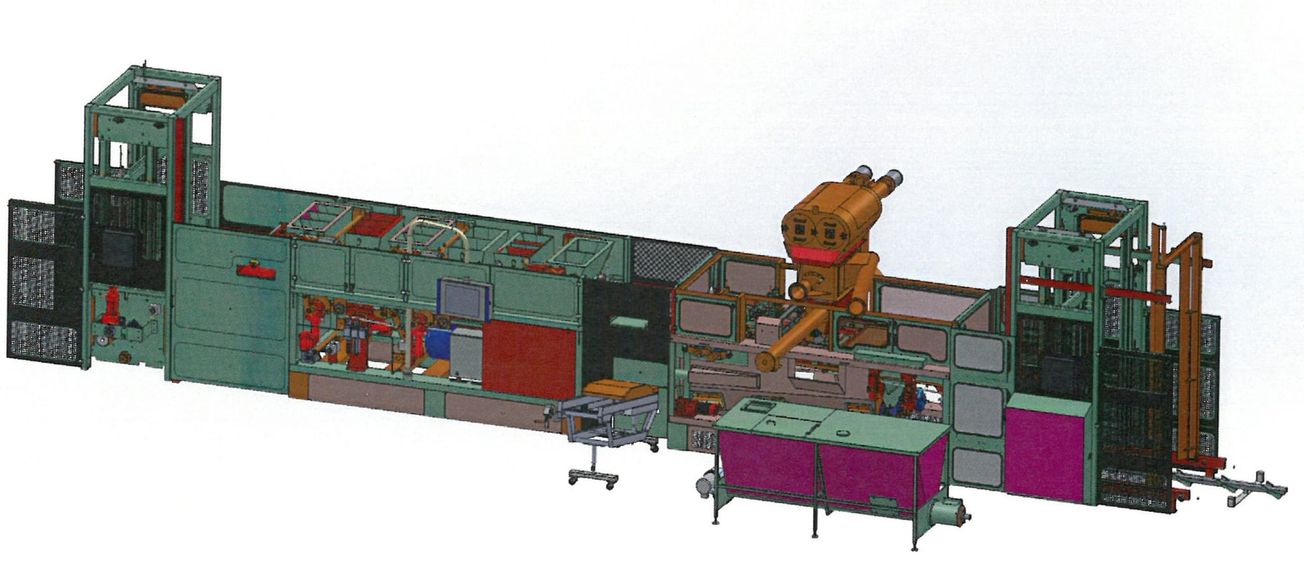
This project portfolio involved the development of specialised production machinery for food, pharmaceutical and cosmetics manufacturing environments.
The work included custom depositing equipment designed around high-volume production requirements, including a swing-hopper depositor and depositing systems operating at approximately 35–40 trays per minute.
Unlike conventional equipment selected from a catalogue, these machines needed to be engineered around specific products, production speeds, operating conditions and customer requirements.
The project strengthened my experience in special-purpose machinery and demonstrated an important transition in my career: from designing individual mechanical components toward understanding complete machines and the manufacturing processes they support.
Project Context
High-volume food and pharmaceutical production requires equipment capable of repeating the same operation accurately over long production runs.
Depositing equipment needs to coordinate several functions simultaneously.
The machine must:
- Receive product consistently
- Meter or distribute the required quantity
- Position product accurately
- Synchronise with trays or downstream equipment
- Maintain production speed
- Accommodate changing product requirements
- Allow cleaning and maintenance
- Remain reliable during repetitive operation
When production rates increase, relatively small mechanical inconsistencies can quickly become significant operational problems.
The engineering therefore needed to consider not only whether the machine could perform the required movement, but whether it could repeat that movement consistently throughout sustained production.
Special-Purpose Machine Development
The machinery was developed around customer-specific manufacturing requirements.
Rather than adapting the production process to a standard machine, the engineering approach involved developing equipment around the intended process.
This required understanding:
Product → Process → Required Motion → Machine Architecture
The resulting machine configuration could then be developed around the required production sequence.
This approach is fundamentally different from designing an isolated mechanical component.
Every major subsystem influences another.
Changes in product properties can influence depositing behaviour.
Changes in tray geometry can affect machine timing.
Changes in production speed can affect motion, structural requirements and synchronisation.
The project therefore required systems-level mechanical thinking.
Mogul Line Engineering
Mogul production lines require controlled product deposition into trays or moulds as part of a repetitive manufacturing process.
The depositing machine therefore forms part of a wider production system rather than operating independently.
The engineering needed to consider interfaces with upstream and downstream equipment.
The basic process relationship can be viewed as:
Product Supply → Depositing System → Tray Movement → Product Placement → Downstream Processing
For the machine to perform effectively, these activities need to remain coordinated.
This introduced valuable experience in designing equipment around production-line timing and interfaces.
High-Speed Production Requirements
Some of the depositing systems were designed around production speeds of approximately 35–40 trays per minute.
At these operating rates, machine behaviour needs to be consistent.
Small delays or variations that may appear insignificant during a single cycle can become major production issues when repeated thousands of times.
Engineering considerations therefore included:
- Cycle time
- Repeated motion
- Mechanical timing
- Component durability
- Product consistency
- Tray positioning
- Machine synchronisation
- Reliability
This strengthened my understanding of an important manufacturing principle:
Production equipment must be designed for the complete operating cycle, not simply for one successful movement.
Swing-Hopper Depositor
One of the specialised systems within the project portfolio involved development of a swing-hopper depositor.
The hopper arrangement needed to coordinate product handling with the required depositing sequence.
The mechanical system therefore needed to consider movement, positioning and timing as part of a repeating production cycle.
The concept required attention to the relationship between:
- Hopper movement
- Depositing position
- Product delivery
- Tray location
- Machine timing
- Surrounding mechanisms
This type of mechanism development strengthened my understanding of mechanical systems in which motion needs to be both controlled and synchronised.
Depositor Manifold Development
The wider project portfolio also included volumetric depositor arrangements.
Depositor manifolds need to distribute material across multiple depositing positions while maintaining acceptable consistency.
This introduces several engineering considerations:
- Flow distribution
- Multiple discharge points
- Mechanical alignment
- Product characteristics
- Cleaning access
- Manufacturing tolerances
- Maintenance
The manifold cannot be considered independently of the machine.
Its geometry, position and operating behaviour need to integrate with the tray-handling and machine-motion systems.
This reinforced the need to consider individual components as part of a complete production architecture.
Automation and Synchronisation
The machine portfolio incorporated automated systems where mechanical movements needed to occur in a defined sequence.
Where servo-controlled motion or synchronised mechanisms were used, mechanical and automation requirements needed to work together.
Mechanical design determines:
- The physical movement required
- Available travel
- Load
- Geometry
- Structural support
while controls determine:
- When movement occurs
- How movement is synchronised
- Position and speed control
- Machine sequencing
Successful automated equipment requires these two disciplines to work together.
This project helped strengthen my understanding of the interface between mechanical engineering and automation.
Product Variability
Special-purpose machinery often needs to process more than one product configuration.
Different products may have different:
- Flow characteristics
- Dimensions
- Deposit quantities
- Tray arrangements
- Processing requirements
The equipment therefore needed sufficient adaptability to support the intended range of production.
This required consideration of adjustable components, machine settings and configurable product-handling arrangements.
Designing for controlled flexibility can significantly improve the long-term usefulness of production equipment.
Hygiene and Production Environment
Food and pharmaceutical environments introduce requirements beyond conventional machine performance.
Equipment needs to consider cleaning and product-contact conditions as part of the engineering design.
Depending on the specific machine area, considerations included:
- Material selection
- Surface accessibility
- Cleaning access
- Product accumulation
- Machine geometry
- Component removal
- Maintenance access
These requirements affect how mechanical components are designed and arranged.
A machine that performs mechanically but is difficult to clean or maintain may not be effective within the production environment.
Mechanical Design
Mechanical development involved translating the required production process into working machine assemblies.
This required understanding how individual elements interacted.
Engineering considerations included:
- Machine frames
- Hopper arrangements
- Depositing components
- Manifolds
- Guides
- Moving assemblies
- Support structures
- Product-contact areas
- Adjustment mechanisms
- Machine interfaces
Each subsystem needed to perform its own function while remaining compatible with the wider machine.
This is where special-purpose machine development differs significantly from isolated component design.
Design for Manufacture
The machinery also needed to be manufacturable.
Design decisions therefore needed to consider practical production methods including:
- Machining
- Welding
- Sheet-metal fabrication
- Purchased components
- Assembly
- Adjustment
- Inspection
- Maintenance
The relationship between design and workshop capability was important.
Complex geometry may sometimes provide theoretical advantages, but it also needs to be manufactured, assembled and maintained economically.
This reinforced the principle:
Engineering performance and manufacturing practicality need to be developed together.
Assembly and Machine Building
Special-purpose machine development ultimately brings many individually manufactured components together into one working system.
This creates another layer of engineering complexity.
The assembly process needs to consider:
- Component interfaces
- Alignment
- Fastener access
- Adjustment
- Machine sequence
- Installation of purchased components
- Access for maintenance
- Future replacement of wear components
Understanding these relationships helped develop my appreciation for the complete machine lifecycle rather than only individual engineering drawings.
Machine Integration
The machines needed to function within existing or planned production lines.
This meant considering more than their internal operation.
Interfaces with surrounding systems could include:
- Incoming product
- Tray conveyors
- Product transfer
- Downstream processing
- Packaging equipment
- Operator access
- Services
- Cleaning areas
This systems-level integration is an important part of production engineering.
A machine can perform perfectly in isolation but still create problems if it does not integrate effectively with the rest of the manufacturing process.
Customer Requirements
Different customers and products created different operating requirements.
The project portfolio included machinery developed for organisations including Nature's Product, Tigerbrands, Pharmavite, Sweetcandy, Santacruz, Church and Vite, and Interpack.
This required engineering solutions to be adapted rather than assuming that one configuration could satisfy every production environment.
Working across different applications strengthened my experience in translating customer requirements into engineering decisions.
The process can be represented as:
Customer Requirement → Production Requirement → Engineering Specification → Machine Design
This relationship later became increasingly important in my product-development and project-delivery work.
Commissioning Perspective
The original project portfolio records machine development extending through implementation and commissioning.
Commissioning is where engineering assumptions meet actual production conditions.
At this stage, practical issues may become visible around:
- Timing
- Alignment
- Product behaviour
- Adjustment
- Machine interaction
- Operator use
- Repeatability
This reinforces why special-purpose machine development benefits from an iterative approach.
The engineering process does not always stop when the drawings are completed.
Feedback from machine build and operation can lead to further refinement.
Project Deliverables
The project portfolio included work associated with:
- Special-purpose machine development
- High-speed depositing systems
- Swing-hopper depositor development
- Volumetric depositing arrangements
- Production-line equipment
- Mechanical system development
- Machine frames and assemblies
- Product-handling systems
- Automation and synchronisation considerations
- Manufacturing documentation
- Design-for-manufacture considerations
- Machine assembly support
- Production-line integration
- Engineering support through machine development
Specific responsibilities varied between machines and customer applications.
Project Outcome
The project portfolio resulted in a number of special-purpose production machines developed for food, pharmaceutical and cosmetics manufacturing environments.
Systems included high-output depositors designed around production rates of approximately 35–40 trays per minute and customer-specific depositing configurations.
The professional value of this experience was significant.
It required understanding the relationship between:
Product + Machine + Automation + Manufacturing + Production
rather than concentrating only on individual components.
This systems-oriented mechanical engineering experience subsequently became highly transferable to my later product-development, plant-engineering and manufacturing-improvement work.
Capabilities Demonstrated
Special-Purpose Machine Design
Developing machinery around specific customer and manufacturing requirements.
Manufacturing Engineering
Understanding how equipment influences and integrates with production processes.
Mechanical Systems Design
Developing interconnected components and assemblies rather than isolated parts.
Automation Integration
Understanding the interface between mechanical motion and automated machine sequencing.
High-Speed Production Equipment
Considering repeatability, timing and reliability under sustained production conditions.
Product Handling
Developing systems around different materials, products and tray configurations.
Design for Manufacture
Connecting mechanical design with machining, welding, fabrication and assembly requirements.
Machine Building
Understanding how individual engineered components become a complete production machine.
Production-Line Integration
Considering equipment interfaces with upstream and downstream manufacturing processes.
Customer Requirements Translation
Turning production needs into engineering specifications and machinery concepts.
Hygiene-Conscious Engineering
Considering cleaning, accessibility and production-environment requirements in equipment design.
Commissioning Awareness
Understanding that machine performance ultimately needs to be demonstrated within the real production process.
Career Development
This project portfolio represents a major stage in my engineering development.
Earlier in my career, my experience was heavily grounded in tooling, components, mechanical drawings and individual assemblies.
Special-purpose machine building required a wider engineering perspective.
The design process expanded from:
Part → Assembly
into:
Mechanism → Machine → Production Line
I needed to understand not only how an individual component worked but how it contributed to the complete production cycle.
That required thinking about:
- Mechanical function
- Timing
- Product handling
- Manufacturing
- Assembly
- Automation
- Reliability
- Cleaning
- Production throughput
- Customer requirements
Those capabilities became an important foundation for my later progression into product development and manufacturing engineering.
The scale of my work has continued to broaden:
Tooling → Components → Machines → Manufacturing Systems → Process Improvement → Engineering Projects
Today, my focus increasingly sits at the project and operational level, including scope, stakeholders, contractors, cost, implementation, commissioning and handover.
However, experience with special-purpose machinery remains an important technical foundation.
It enables me to understand what needs to happen between a project requirement on paper and a functioning piece of equipment operating on a factory floor.