Project Stage: Proof-of-Concept
Project Period: 2020
This project involved developing a mechanical concept for a navigation buoy capable of adapting automatically to changing water levels.
Conventional fixed-height buoys can become less visible when water levels rise significantly. The design challenge was therefore to explore whether the visible section of a buoy could adjust mechanically with changing water conditions without relying on motors, sensors or powered control systems.
My contribution focused on developing a passive telescoping concept driven by buoyancy, considering how multiple sliding sections, stability, marine exposure and navigational visibility could be brought together into a practical engineering concept.
The project is a useful example of my approach to engineering problem-solving: understand the physical problem, identify the governing principle and seek the simplest mechanism capable of achieving the required function.
Project Context
Navigation markers need to remain visible across changing environmental conditions.
A conventional buoy normally has a fixed relationship between its body and visible marker.
Where water levels vary considerably, maintaining an appropriate visible height can become more challenging.
The concept therefore explored a simple engineering question:
Could buoyancy itself be used to automatically adjust the height of the navigation marker?
Rather than immediately introducing electronics, sensors or powered actuators, the concept investigated whether the environmental change could provide the force required to create the response.
This led to development of a passive telescoping mechanism.
Engineering Problem
The main requirement was to maintain useful marker visibility as water elevation changed.
The concept needed to consider several interconnected requirements:
- Variable water levels
- Buoyancy
- Mechanical extension and retraction
- Stability
- Corrosion resistance
- Environmental exposure
- Visibility
- Mechanical simplicity
- Reliability
- Maintenance requirements
The project therefore combined mechanical design principles with the behaviour of a floating structure in a changing environment.
Passive Engineering Approach
A key objective was to avoid unnecessary mechanical and electrical complexity.
The concept was developed around a fully passive operating principle.
Rather than measuring water level electronically and activating a powered mechanism, the design used changes in buoyancy to influence the position of the telescoping sections.
The intended operating principle was:
Water Level Changes → Buoyancy Response → Telescopic Movement → Marker Height Adjustment
This approach reduced dependence on:
- Electrical power
- Sensors
- Control systems
- Motors
- Electronic communication
From an engineering perspective, eliminating these systems also had the potential to reduce the number of components exposed to a difficult marine environment.
Telescopic Mechanism
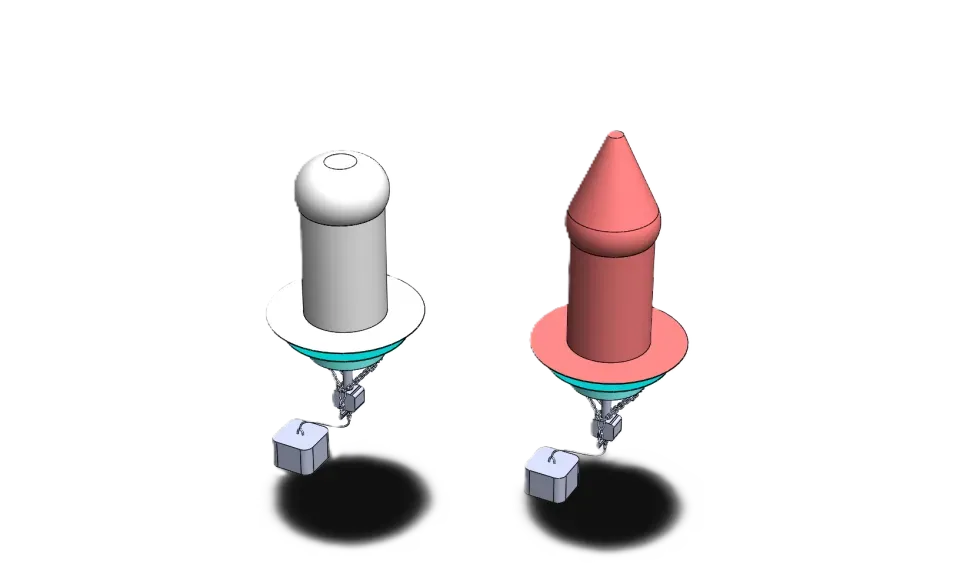
The core concept used multiple concentric sections capable of sliding relative to one another.
As water conditions changed, buoyancy within the system was intended to progressively influence the extension of the telescoping sections.
The concept therefore needed to consider the relationship between:
- Section geometry
- Buoyant force
- Sliding movement
- Available extension
- Mechanical guidance
- Stability
The mechanism had to remain sufficiently constrained to maintain alignment while still allowing movement.
This balance between guidance and freedom of movement is common in telescoping mechanical systems.
Too much clearance can create instability.
Too little clearance can increase the potential for friction or binding.
Mechanical Simplicity
One of the strongest aspects of the concept was its simplicity.
The intended functionality was achieved through physical principles rather than a complex control system.
This reflects an engineering principle that has influenced many of my later projects:
Do not introduce complexity unless it adds necessary value.
A simpler system can potentially provide advantages in:
- Reliability
- Maintenance
- Manufacturing
- Inspection
- Energy consumption
- Lifecycle cost
Particularly in remote or difficult-to-access environments, reducing the number of active systems can be valuable.
Environmental Conditions
Marine and waterway equipment operates in an aggressive environment.
The concept therefore needed to consider exposure to:
- Water
- Moisture
- Corrosion
- UV radiation
- Wave movement
- Wind
- Debris
- Long-term outdoor exposure
These conditions influenced both the proposed materials and the overall mechanical arrangement.
The concept considered marine-grade composite materials as one potential way of improving corrosion resistance and reducing dependence on heavily protected metallic structures.
Detailed material selection would require further engineering assessment based on the intended deployment environment and service life.
Stability
A telescoping buoy introduces an additional stability challenge.
As the visible structure extends upward, its geometry and response to wind and wave action can change.
The concept therefore included stabilising fins intended to support performance under disturbed water conditions.
This highlighted an important engineering relationship:
Improving one function can create another engineering requirement.
Increasing marker height may improve visibility, but it can also affect stability.
The complete design therefore needs to consider both requirements together.
Visibility
Maintaining visibility was the primary purpose of the concept.
A high-visibility reflective marker head was incorporated into the design concept to assist identification under different lighting conditions.
The telescoping system was intended to maintain a more consistent visible marker position as the water level changed.
Potential applications considered for the concept included:
- Rivers
- Ports
- Tidal waterways
- Flood-prone areas
- Marine construction zones
- Temporary navigation marking
These were potential applications rather than completed deployments.
Design for Harsh Environments
This project helped reinforce the importance of designing around the environment in which equipment will operate.
A mechanical solution that works effectively in a controlled workshop may behave very differently when exposed continuously to water, sediment, wave action and weather.
The concept therefore required consideration of questions such as:
- Could telescoping sections remain free-moving?
- How would contamination affect sliding interfaces?
- How could corrosion be minimised?
- How would the design respond to wave loading?
- What maintenance would be required?
- Could components be inspected or replaced?
These questions would become increasingly important if the concept progressed toward prototype development.
Reliability Through Fewer Systems
Removing motors, sensors and electronic controls from the core concept was not simply a cost decision.
It represented a reliability strategy.
Every additional subsystem creates another potential failure mode.
For equipment potentially operating remotely on waterways, maintenance access can be difficult.
A passive mechanism therefore offered an attractive conceptual direction because the operating principle was based primarily on mechanical geometry and buoyancy.
Further prototype testing would still be required to evaluate whether the concept could operate reliably under real-world conditions.
Concept Development
The project remained at the proof-of-concept stage.
The engineering work established the underlying operating principle and developed a conceptual configuration showing how the telescoping system could function.
Further development would have required activities such as:
- Detailed buoyancy calculations
- Hydrostatic assessment
- Stability analysis
- Material evaluation
- Sliding-interface development
- Prototype manufacture
- Environmental testing
- Wave and wind testing
- Durability testing
- Marine safety review
- Regulatory assessment
These activities were outside the completed project scope.
Being clear about this boundary is important because the value of the project lies in concept engineering and innovation, not in claiming a fully validated marine product.
Project Deliverables
The project work included:
- Identification of the water-level visibility problem
- Passive buoy-adjustment concept
- Telescoping mechanical architecture
- Concentric sliding-section concept
- Buoyancy-driven operating principle
- Stability considerations
- Stabilising-fin concept
- Marine-environment material considerations
- Reflective navigation-marker concept
- Mechanical concept documentation
- Proof-of-concept design development
The project did not progress into detailed engineering, prototype validation or commercial deployment.
Project Outcome
The project produced a defined mechanical concept demonstrating how buoyancy could potentially be used to adjust the visible height of a navigation marker without powered actuators or electronic controls.
Although the concept was not progressed beyond proof-of-concept stage following budget realignment, it provided valuable experience in using fundamental engineering principles to address an environmental problem.
The most important aspect of the project was the design philosophy:
Use the physical behaviour of the operating environment as part of the solution.
Rather than resisting changing water levels through additional control systems, the design attempted to use the changing buoyancy condition to create the required mechanical response.
Capabilities Demonstrated
Concept Engineering
Taking an identified practical problem and developing a structured mechanical solution.
Mechanical Innovation
Applying telescoping mechanisms and buoyancy principles in a non-standard application.
Passive-System Design
Developing functionality without dependence on motors, sensors or powered controls.
Product Development Thinking
Progressing from problem identification into a defined proof-of-concept architecture.
Environmental Design
Considering how water, corrosion, wave action and outdoor exposure influence engineering decisions.
Mechanical Simplification
Reducing unnecessary system complexity while maintaining the intended function.
Systems Thinking
Considering buoyancy, movement, stability, materials and visibility as interconnected requirements.
Reliability Thinking
Recognising the relationship between component count, active systems, maintenance and potential failure modes.
Future Development Planning
Identifying the additional engineering and validation steps required before a concept could progress toward implementation.
Career Development
The Telescopic Buoy project is useful in my portfolio because it demonstrates engineering thinking at the conceptual stage.
Unlike projects where the requirement was already clearly defined, this work began with a broader question:
How can a navigation marker adapt naturally to changing water levels?
The solution required connecting several principles:
Environment → Buoyancy → Mechanical Movement → Stability → Visibility
This type of thinking strengthened my ability to move beyond modelling predefined components and instead explore how fundamental engineering principles can be used to create a solution.
It also reinforced a principle that has continued throughout my later product, manufacturing and operations work:
Start with the problem and the governing engineering principles before deciding what the solution should look like.
As my career progressed, the scale of the problems changed.
The same thinking moved from:
Mechanical Concept
to:
Product
to:
Equipment
to:
Manufacturing Process
and eventually toward:
Engineering Project Delivery
The Telescopic Buoy project represents an early example of that problem-solving mindset.