Industry: Defence Manufacturing
Project Stage: Engineering Design and Development
This project involved developing a modular girder-based support system to assist with the preparation and painting of large defence-related components within an industrial production environment.
The engineering challenge extended beyond designing a structural support.
Large components needed to be positioned securely while still providing operators with practical access to different surfaces during preparation, coating and inspection activities.
My contribution focused on translating those production requirements into a configurable mechanical system that considered structural support, flexibility, operator access, fabrication and integration with the painting workflow.
The project demonstrates the progression of my work from individual mechanical components toward equipment designed around an entire manufacturing process.
Project Context
Painting large industrial components creates several practical engineering challenges.
Unlike smaller parts that can be placed on standard benches or fixtures, large components can require dedicated support equipment that provides both stability and access.
The support arrangement needed to consider:
- Component size
- Load and support requirements
- Component geometry
- Operator access
- Surface accessibility
- Painting workflow
- Movement around the workpiece
- Production-floor constraints
- Fabrication practicality
- Reuse across different component configurations
A fixed-purpose frame could potentially solve one immediate problem but provide limited value when future components differed in size or geometry.
The concept therefore focused on developing a more adaptable support system.
Understanding the Production Requirement
The first step was understanding how the components needed to move through preparation and painting activities.
The key question was not simply:
How do we support this component?
The wider questions included:
- Which surfaces need to remain accessible?
- Where can the component safely be supported?
- How will operators move around it?
- What working height is practical?
- Can the support arrangement accommodate different components?
- How will the equipment be fabricated and assembled?
- How much floor space will the system occupy?
- Can it be reconfigured when production requirements change?
These operational considerations became inputs to the mechanical design.
Modular Design Approach
A modular girder concept was developed to provide greater flexibility than a dedicated single-use fixture.
The intention was to create a structural framework that could potentially be configured for different component sizes and support requirements.
Modularity offered several potential advantages:
- Greater production flexibility
- Reuse of common structural elements
- Reduced requirement for multiple dedicated fixtures
- Easier adaptation to new components
- Simpler replacement of individual elements
- More efficient storage when configurations were not required
This approach reflected an important manufacturing principle:
Production equipment should support change rather than unnecessarily restrict it.
Mechanical Design Development
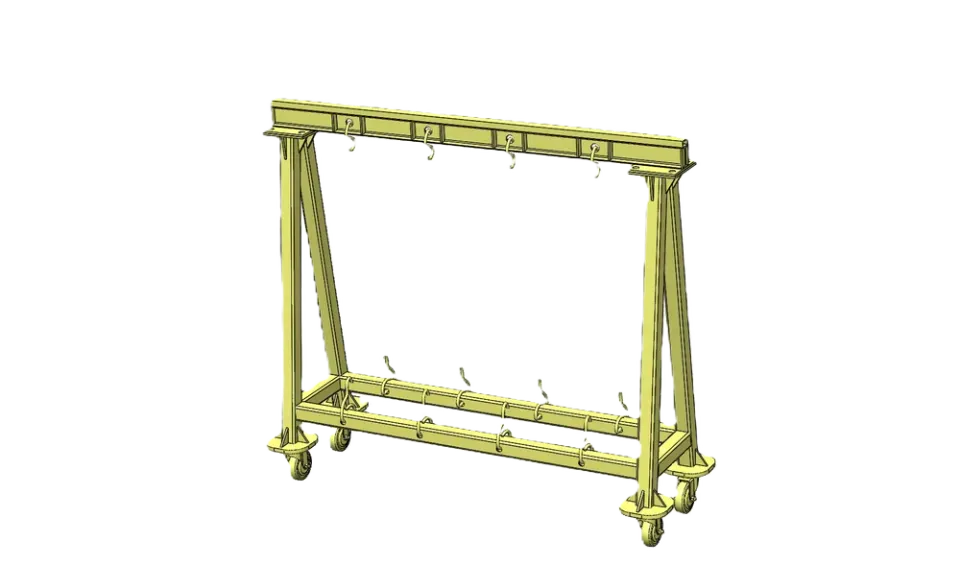
The girder system was developed around a fabricated structural framework capable of supporting industrial components during painting activities.
The design considered the relationship between the primary support members, connection points and potential component-support locations.
The objective was to create sufficient rigidity while retaining the flexibility required for different setups.
Mechanical design considerations included:
- Structural arrangement
- Member positioning
- Connection locations
- Support spacing
- Frame rigidity
- Component interface points
- Access around the workpiece
- Assembly and disassembly requirements
The design therefore needed to balance structural performance with production usability.
Load Path and Stability
Supporting large components requires clear understanding of how loads move through the equipment.
The conceptual load path can be viewed as:
Component → Support Interface → Girder Structure → Base / Supporting System → Floor
Each part of this chain influences the stability of the complete arrangement.
The engineering concept therefore considered factors such as:
- Load distribution
- Support spacing
- Uneven loading
- Centre-of-gravity effects
- Structural rigidity
- Connection integrity
- Overall stability
Final working-load limits and operational configurations would require appropriate engineering verification for the actual components being supported.
The importance of these considerations is that structural capacity alone does not guarantee safe or practical equipment.
A system also needs to remain stable under the real loading arrangement in which it will operate.
Operator Access
One of the principal design requirements was maintaining access to the surfaces being prepared and painted.
A support system can be structurally effective while still reducing production efficiency if it blocks important working areas.
The girder arrangement was therefore considered in relation to the operator as well as the component.
The design sought to maintain practical access for:
- Surface preparation
- Painting
- Inspection
- Touch-up activities
- Repositioning
- General handling
This reflects a wider principle that has influenced much of my later engineering work:
Production equipment needs to be designed around both the product and the people performing the process.
Production Flexibility
Manufacturing environments change.
Different projects may introduce different component sizes, geometries and handling requirements.
Designing a completely new fixture for every variation can increase fabrication cost, storage requirements and lead time.
The modular girder approach therefore considered how common structural elements could potentially be reused and rearranged.
This provided a more flexible engineering concept capable of supporting changing production needs.
The project strengthened my understanding of designing equipment not only for today's task but also with consideration for likely future requirements.
Design for Manufacture
The girder system also needed to remain practical to fabricate.
The design therefore considered conventional structural materials, fabrication methods and connection arrangements.
Key considerations included:
- Standard material availability
- Cutting and preparation
- Welding requirements
- Fabrication access
- Repeatability of common components
- Assembly
- Replacement
- Maintenance
- Potential modification
Using repeatable structural elements can reduce unnecessary manufacturing complexity while supporting a modular equipment architecture.
This approach connects engineering design directly with workshop capability.
Assembly and Reconfiguration
Because flexibility was an important objective, consideration was also given to how the system could be assembled and altered.
A modular system provides limited benefit if every configuration change requires extensive fabrication work.
The design philosophy therefore focused on creating identifiable structural modules and connection points that could support practical configuration changes.
This type of thinking later became increasingly relevant in my product-development and operations-excellence work, particularly where manufacturing equipment needed to adapt to different products or production conditions.
Painting Process Integration
The equipment was developed specifically around the requirements of the painting process.
This meant considering more than support and structural capacity.
The arrangement also needed to consider how operators could work around the component and how the support equipment might influence surface access.
The overall workflow could be viewed as:
Load → Position → Prepare → Paint → Inspect → Reposition if Required → Complete
The girder system therefore formed part of the production process itself.
Its design could influence handling effort, operator access, setup time and flexibility between different jobs.
This systems-oriented thinking is one of the most transferable aspects of the project.
Safety Considerations
Large components and fabricated support equipment introduce potential hazards that need to be considered during engineering development.
Relevant considerations included:
- Component stability
- Structural support
- Uneven loading
- Operator movement
- Pinch or trapping areas
- Access around the structure
- Assembly and reconfiguration
- Handling during setup
Detailed operational risk assessment and engineering verification would form part of any final implementation and commissioning process.
At the design stage, the objective was to ensure that practical safety considerations influenced the equipment concept from the beginning.
Engineering Documentation
The design was developed through CAD and technical documentation so that the concept could be communicated and reviewed.
Engineering documentation provided a basis for considering:
- Overall configuration
- Structural arrangement
- Individual components
- Connections
- Dimensions
- Fabrication
- Assembly
- Potential alternative configurations
Clear technical information is especially important with modular equipment because individual parts need to work together consistently.
The documentation therefore formed an important connection between the engineering concept and potential fabrication.
Project Deliverables
The project work included:
- Review of painting and component-support requirements
- Modular equipment concept
- Girder-system development
- Mechanical design
- Structural arrangement
- Component-support considerations
- Operator-access considerations
- Production-workflow integration
- Design-for-manufacture considerations
- Modular assembly and reconfiguration concepts
- CAD modelling
- Engineering drawings and technical documentation
Project Outcome
The project produced a developed modular girder-system concept intended to support the preparation and painting of large components within a defence-related production environment.
The key engineering value was not simply the fabricated structure.
The project demonstrated how equipment design can be used to improve flexibility within a manufacturing process.
Instead of treating each component as requiring a completely independent support solution, the modular concept explored how a common engineering platform could potentially support different production requirements.
This systems approach helped strengthen my understanding of the relationship between equipment design, production workflow and operational flexibility.
Capabilities Demonstrated
Mechanical Design
Developing fabricated production equipment around defined operational requirements.
Manufacturing Engineering
Considering equipment as part of the wider production process rather than as an isolated structure.
Modular Equipment Design
Creating a configurable concept capable of supporting varying production requirements.
Large-Component Handling
Considering load distribution, stability and support arrangements for large industrial components.
Design for Manufacture
Developing equipment around practical fabrication methods and commonly available materials.
Operator-Centred Design
Considering working access, movement and usability during development.
Workflow Improvement
Understanding how equipment design can influence preparation, painting, inspection and handling activities.
Design Standardisation
Exploring reusable and repeatable structural elements rather than relying solely on dedicated one-off fixtures.
Safety by Design
Considering load stability, access and operator interaction during concept development.
Technical Documentation
Translating the equipment concept into information suitable for engineering review and potential fabrication.
Engineering Project Development
Progressing a manufacturing requirement through problem definition, concept development, mechanical design and engineering documentation.
Career Development
This project helped develop an area of engineering thinking that has become increasingly important throughout my career:
designing systems rather than isolated parts.
The visible output was a girder structure, but the broader engineering problem involved:
- Large component handling
- Manufacturing workflow
- Operator access
- Production flexibility
- Fabrication
- Safety
- Future product variation
Solving these issues required looking at how the equipment interacted with the complete production environment.
This same systems mindset later became central to my work in product development, manufacturing-line improvement and operations excellence.
My engineering approach progressively evolved from:
Component → Assembly
to:
Assembly → Equipment
and eventually toward:
Equipment → Process → Manufacturing System → Project Delivery
That progression has provided the technical foundation for my current focus on engineering project delivery, operational improvement and larger multidisciplinary project responsibilities.